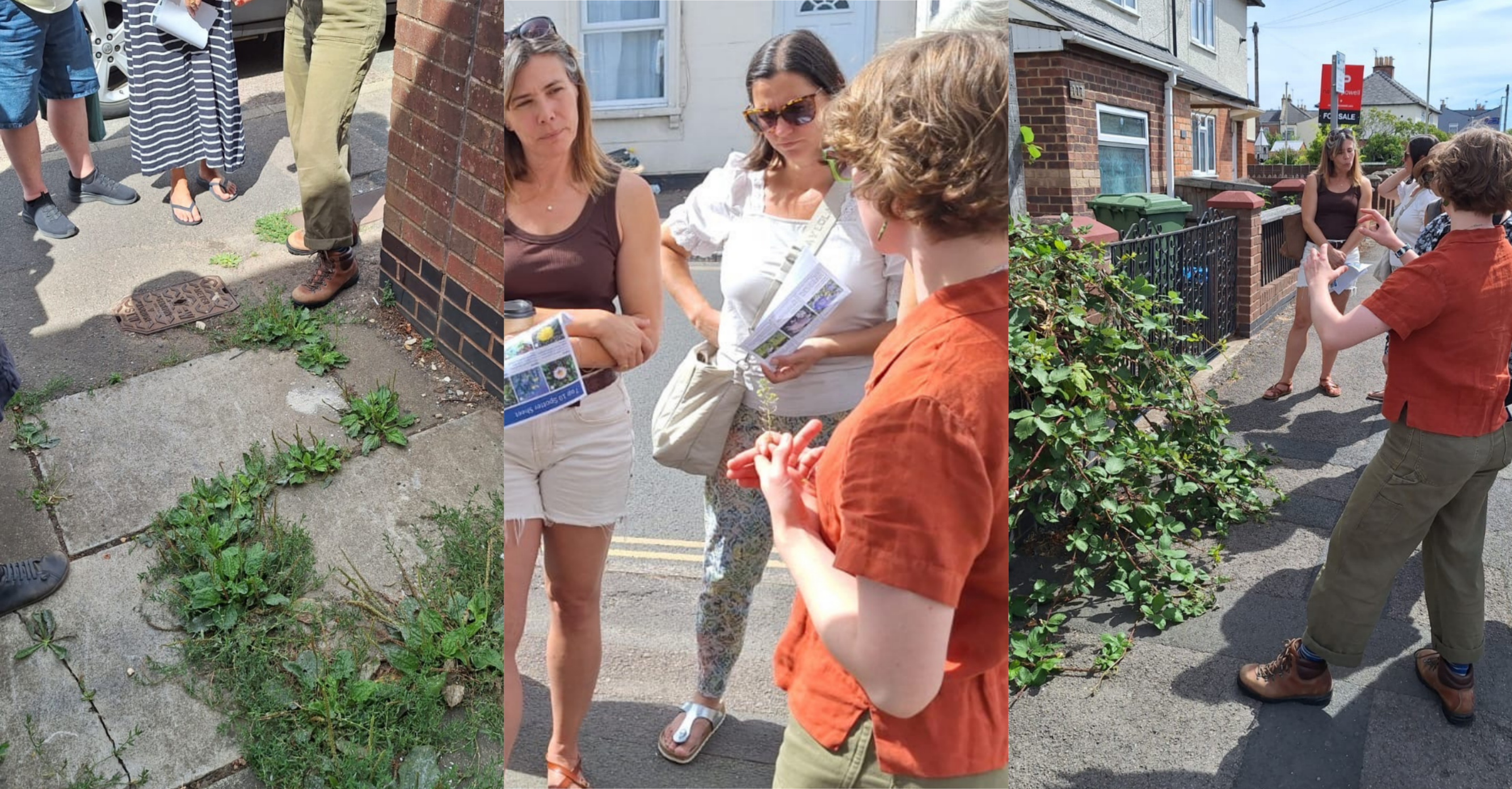
One of the lovely things about our wild plant walk at Cheltenham Gardens for Nature was seeing people begin to notice plants they might normally walk straight past.
Urban spaces can be surprisingly rich in plant life. Between paving slabs, in cracks in walls and along the edges of pavements, wild plants find ways to grow – and once you start looking, there is an extraordinary amount to discover.
One participant was struck by the beauty of the flowers on a mallow growing beside the pavement. Elsewhere, we stopped to look more closely at brambles and learnt that there are over 300 subspecies, with tiny differences between them. Plants that are often dismissed as weeds can provide valuable habitat and shelter for wildlife.
In Pittville Park, we explored an area that has been left unmown (and seeded with saved wild flower seeds by the Green Spaces Team and Friends of Pittville Park) and found a variety of grasses and wildflowers. It was fascinating to observe how similar in form so many of the wildflowers are to our cultivated species, especially the wild carrot! The loud chorus of grasshoppers was a good indication of how much wildlife this kind of habitat can support.
There were plenty of other encounters too – pollinators visiting buddleia, dragonflies and water skaters around the water – all reminders of how much life can be found when we slow down and look closely.
Perhaps the biggest takeaway from the walk was simply the value of noticing. The plants we overlook can be an important part of the wider ecosystem, and paying attention to the nature around us can change the way we see the places we live.
A big thank you to Rosa and Richard for leading the walk and helping us look a little more closely at the wild plants of Cheltenham.