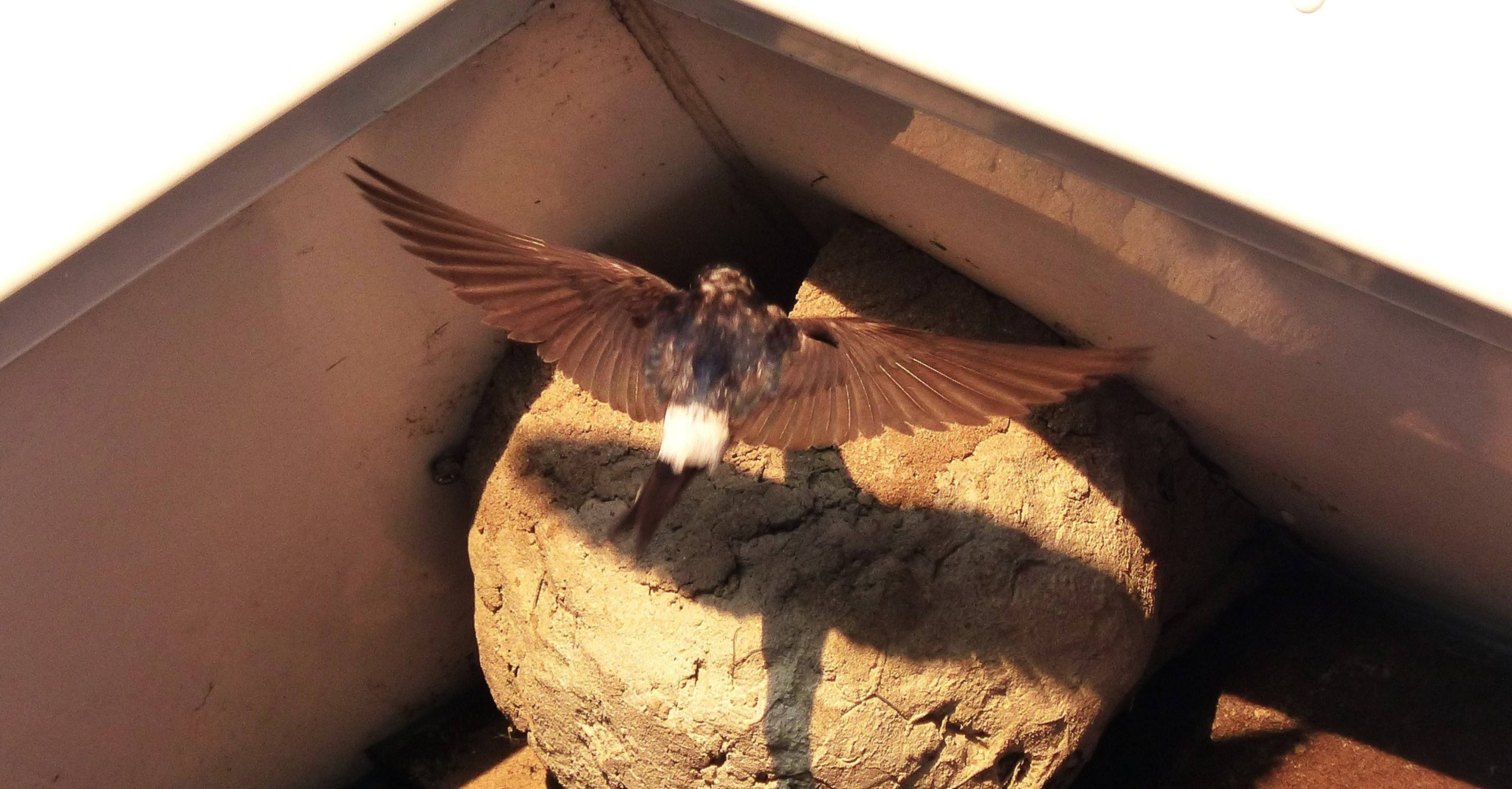
Tom Mabbett has been quietly keeping an eye on Swifts and House Martins in Charlton Kings for years. What began as noticing a few nests near his home has grown into a practical effort to support and strengthen local colonies – putting up nest cups, monitoring breeding success, and encouraging neighbours to get involved.
Based in Detmore Close, Tom has seen first-hand how small changes to our homes can make a real difference to these summer visitors. Here, he shares his experience in his own words.
“It became an aim of mine to find where the remaining birds were.”

“The first house I owned in Charlton Kings was on Croft Road. When I moved in, I was delighted to see signs of an old House Martin nest on the house, and two pairs breeding on the house two doors down. Swifts were breeding on an adjacent road too – so of course House Martin and Swift boxes were duly put up.
Sadly, they weren’t used. Plastic soffits on the nearby house meant the House Martins on Croft Road were no more. That’s when it became an aim of mine to find where the remaining birds were in Charlton Kings.
When I moved to Detmore Close in 2021, I discovered there was a lovely House Martin colony here – and my brother Greg, who already lived across the road, had breeding birds. Fantastic! Up went artificial House Martin cups and a Swift box, but it wasn’t until 2024 that House Martins also colonised my house. A brilliant moment.
Greg had been carefully monitoring his birds and noticed that Magpies had been attempting to peck through the natural mud nests to reach the young. He came up with the idea of making artificial cups from chicken wire and cement, screwing them under the eaves to protect the nests.
It worked extremely well. Birds instantly began using his homemade cups, fledging young and even having multiple broods.
After adding one of these cups to my own house, I was delighted that in 2024 a pair of House Martins successfully used it and fledged three young. The daily sight and sound of these brilliant birds zooming in and out of the nest was a real joy – and it fuelled my ambition to try to get more cups up on nearby houses.
In 2025, Blue Tits decided they quite liked the look of the House Martin cup themselves (despite having a perfectly good tit box designed for them!), but I’m really hopeful the House Martins will return in 2026.
We think there are around ten pairs in or very close to Detmore Close, and on 26th August last year I watched at least 60 birds swirling overhead, their distinctive buzzing calls filling the air.
They seem to be holding their own here – possibly even increasing. Long may that continue. And we can all help.”
About Tom Mabbett
Tom has been fascinated by wildlife since childhood and it was at primary school that he set about learning all the British bird species and has been enjoying finding, watching and learning about them ever since.
In Tom’s spare time he is happiest out in the field on his local patches around the Cotswolds in his home county of Gloucestershire. Tom is lucky to have an area of land he manages as a small nature reserve and a lot of Tom’s time is now spent trying to inspire his children Max and Harry to enjoy the outdoors and our wildlife.
Tom has also helped set up the Swift and House Martin Support Group in Charlton Kings.
Why this matters
House Martins are red-listed in the UK, meaning their numbers have declined significantly over recent decades. Changes to buildings – including smooth plastic soffits – mean there are fewer places for them to anchor their traditional mud nests. Predation and weather pressures add further challenges.
But as Tom’s story shows, small practical steps can make a real difference.
A simple way to help: Put up House Martin cups before April
If you’d like to support House Martins locally:
- Install artificial House Martin cups under the eaves of your house before they return from Africa (typically April).
- Ideally place two or more cups together – they are colonial nesters.
- Choose a spot with a clear flight path and some shelter from heavy rain.
- If possible, talk to neighbours – colonies work best when several houses host nests.
Small actions like this can help strengthen existing colonies and encourage new ones.
Where to buy House Martin cups
Ready-made artificial cups are available from:
You can also find guidance on building your own cups (as Greg did) through bird conservation forums and local swift groups.
Recommended resources
- Swift Conservation – detailed guidance on Swift and House Martin nest provision
- RSPB – House Martin advice pages
- BTO (British Trust for Ornithology) – species information and monitoring guidance
- Local swift and house martin groups in Gloucestershire (often found via Gloucestershire Wildlife Trust networks)